
World-Wide-Western: On Ari Aster’s Eddington

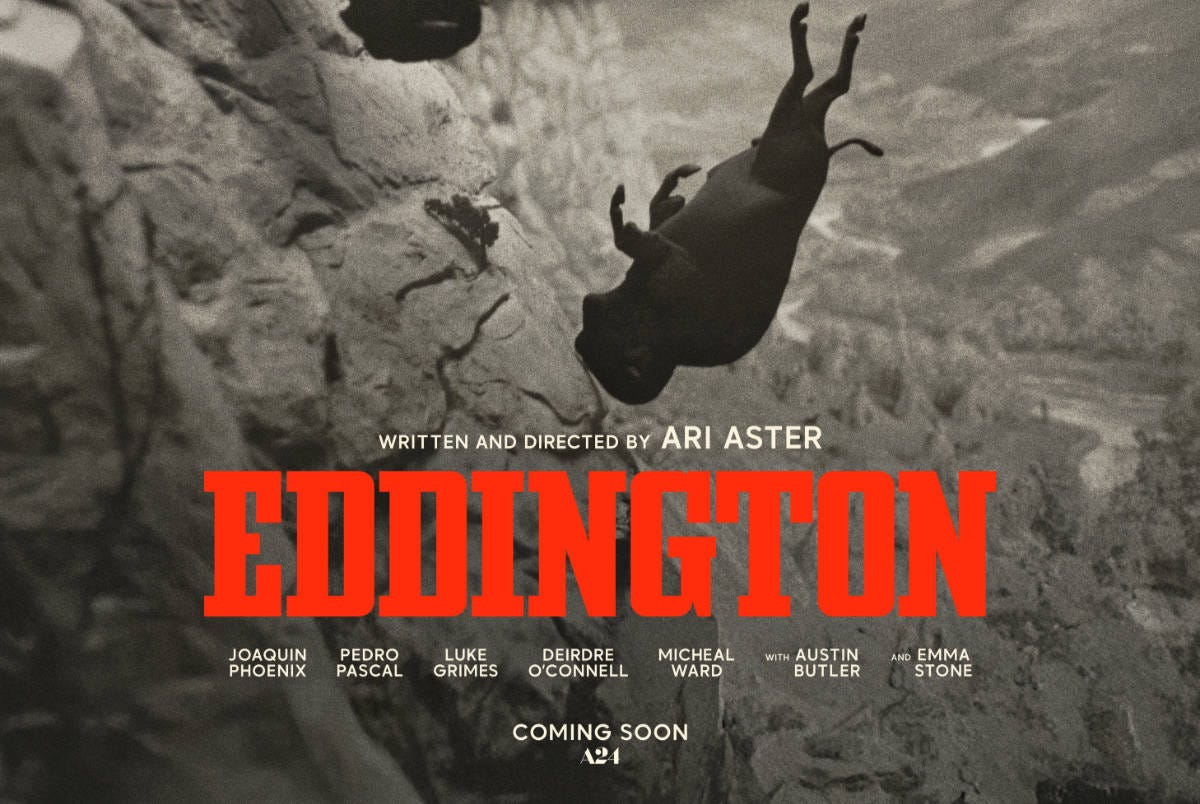
The internet is uncinematic. It’s not a discrete object, it has no single narrative drive, and its aesthetic is legion. As it evolves, its old form is shucked off, its pages deleted and unarchived. It’s unable to historicise itself, as it’s too big to put its own arms around. If the internet most commonly ‘occurs’ anywhere, it’s in the unseen feedback loop between the viewer and the screen. This is doubly difficult for a filmmaker, because not only is this process invisible, it's also boring to look at. In the late 1990s, narrative films that made use of the early internet tended to rely on reverse shots of an illuminated face and information appearing on a screen, in the same way that older films might depict characters looking at microfilm, or newspaper archives. However, in these older examples, these scenes have a terminal point; there’s always a clue somewhere in the archive, an incriminating article or photograph. The internet itself is not terminal, it’s multifarious. It’s anti-narrative.
Some narrative films have attempted to render the internet by taking place entirely within the screen. Unfriended and its sequel Dark Web managed to wring a surprising amount of suspense from watching windows open and close on a browser, but also relied on inset video of the protagonists to provide the film’s emotional undercurrent. Now that most of us experience the internet on our phones, the visual challenge is different. Directors have come up with cute renditions of the iconography of the smartphone – Park Chan Wook’s phone POV shots in Decision to Leave, for example, or the many films where texts appear on the screen themselves alongside the character reading them – but this is fundamentally no different than age-old cinematic techniques like the split-screen phone call. More recently, livestreaming, despite its greater degree of visual curation, is made to be viewed in the moment, no matter what parts later get snipped out asynchronously for compilations on YouTube. It’s also formally anti-dramatic, a moment in life; getting a coffee, queuing for a concert, or playing a video game.
Incorporating the internet into a Western – a narrative form visually concerned with wide vistas, small communities and moments of decisive action – is a tantalising prospect. Ari Aster’s fifth film, Eddington, attempts to fuse the iconography of the Western with the post-COVID online world, showing how the avalanche of conspiracy, protest and misinformation of 2020 affects a small town in New Mexico. The plot is classic Western territory; a conservative sheriff, Joe Cross (Joaquin Phoenix) clashes with a liberal mayor, Ted Garcia (Pedro Pascal) as they both run for mayoral election. But the Western iconography gets a fresh twist; the streets are empty because the population is either locked down or keeping away from each other. When two men stand on opposite sides of the street and face each other, it’s not for a duel but because they’re respecting the two-metre COVID rule. As the film progresses, the fight between the two men gets increasingly rancorous and bloody, escalated by concurrent events such as a Black Lives Matter protest attended by Ted’s son Eric, social justice activist Sarah and loner Brian, and the appearance of a local cult led by Vernon Peak (Austin Butler). Joe’s wife Louise, who is seemingly a victim of childhood abuse, falls under the spell of Vernon, rendering Joe ever more unstable.
Eddington is structured like many Westerns – an escalating feud ending in a violent shootout – but Aster aims to complicate this form by leaning into the kind of reality-defying internet conspiracy that has characterised the pandemic era. Specifically, he refuses to situate the attendant online noise as mere disruption and shadowplay: events in the final third of the film suggest that some of the more outlandish theories that Joe believes actually exist. Aster seems to indicate here that the sleep of reason births different realities that are then thought into existence as self-fulfilling prophecies; that if you believe enough in, say, a plane full of Antifa super soldiers, the world will make that come true. This idea – that the internet is an incantatory space where radical delusion can become real, and that this results in the breakdown of a genre form as stalwart as the Western – is an interesting one, but it persistently fails to land in a film too overly preoccupied with glib provocation, and which can’t seem to decide if it wants to work within the Western tradition or become a broad, gonzo South Park-style satire.
Aster’s career has been characterised by this uneasiness. He’s a technically gifted filmmaker, and his anxious, discomfiting style betrays the influence of the abrupt-shock technique of Michael Haneke, of whom Aster is an avowed fan. But where Haneke uses moments of violent disruption to create a rupture in the audience’s positionality or complacency, Aster tends more towards the structure of the sick joke. I found myself thinking of Haneke when watching Eddington, not least because his most recent film, 2017’s Happy End, begins with a shot of a dying animal being filmed on an iPhone. Haneke – as with many of his weaker films – doesn’t bring much to this image other than a kind of priestly despair. As a student of Baudrillard and Debord, the arch pessimists of the mediated age, Haneke often tends towards a conceptualising of the corruption of the social world via the weightlessless of mediation, one not unlike the criticisms of those French critics of the relativism of postmodern culture. Internet, television, smartphones – for Haneke they’re all fingers of the same fist. His strongest films – The White Ribbon, Code Unknown, Amour – don’t rest their entire weight on this critique, and rely less on shock than a sense of disrupted community, one that still maintains the possibility of co-operation, whether or not it is subsequently snatched away. With Haneke there’s a tension between the fundamental vulgarity of the shock moment – the throat-cutting in Cache, the murder in Benny’s Video – and his attempt to deny his audience a frisson of excitement, lest they become complicit.
Aster, an American filmmaker raised in the Reagan era, is more comfortable with vulgarity. Comedy is fundamental to his work, and his use of shock often lies directly on the border between the gasp of horror and the stifled laugh. The characteristic image of this approach for me is the shock-cut to a decapitated child’s head in Hereditary. This moment, possibly the most frequently cited in Aster’s oeuvre, indicates to the audience that the film has a flagrant disregard for what’s acceptable, but it also undercuts the genuine horror of the scene that immediately precedes it, in which we overhear the offscreen sound of the child’s mother discovering her headless body. When I saw Hereditary on release, the image struck me as entirely self-defeating, a pin stuck in the ever-inflating escalation of horror the film had thus far obtained. It felt like a yuk-yukking kid in the playground showing you a snuff video on his phone. Hereditary is often the work of a filmmaker defeated by his own glibness – the characters are sketched puppets, dolls in one of the many doll’s houses found in the film, ants under a magnifying glass. It’s this feeling that I can’t quite shake about Aster’s films, this concept of predetermined fate, a nasty punchline that can and will happen to anyone. If Haneke’s motif is “There is hope, but not for us”, Aster’s might be something pithier: You’re fucked lol.
The Western, as opposed to Horror, is a genre where this kind of provocation doesn’t really work. While Horror functions heavily around the constant escalation and de-escalation of suspense and shock, the Western has a different temporal quality. It’s one of the reasons there are so few Horror/Western hybrids – unlike the hidden threats of the Horror genre, the Western is concerned, fundamentally, with visibility, with the vista, the limits of civilisation, the small caravan or posse in a vast space, the saloon where the town gathers and works its business out, and the concept of the law. Things don’t really come out of nowhere in the Western – they tend to be announced in advance. With the internet, Aster finds a hiding place in this vast open space, a shadow world from which monsters spring. This is a concept with a lot of potential, and a formally disruptive one for the genre. Instead of the hazy silhouettes of the antagonists riding across the desert giving the townspeople time to run and hide, we’re in a situation that’s closer to the paranoia of the American Puritan community, where threats can spring from within or without at any time. This allows Aster to ascribe a duality to characters, to undercut their motives. Are the BLM protestors doing it from a sense of justice, or to look good on TikTok? Is Joe paranoid because there is genuinely a plot against him, or because he’s been psychologically poisoned by what he’s reading on his phone? This satire, though, ultimately feels glib rather than discomfiting. The hypocrisy of young American white liberals was being mercilessly satirised as long ago as Invisible Man and A Confederacy of Dunces; there’s nothing in Eddington that isn’t in those. In fact, the film’s satire is surprisingly toothless – liberals are hypocritical, conservatives are psychotic, libertarians are self-righteous – compared to, say, the scorched-earth approach of an episode of South Park. It amounts more to a ‘gotcha’ – again we return to the structure of the sick joke – than a genuine social inquiry.
The Classic Western is itself a form with a strong satirical or iconoclastic history. This is commonly forgotten, perhaps due to the historicising of the Revisionist Western, a term which tends to bifurcate the genre roughly on either side of the 1960s. The loosening censorship of that decade, the proliferation of transgressive Westerns from Europe and the burgeoning counterculture led to the delineation of this new term; Westerns from this era are often described as having a fresh perspective on, among other things, the genocide of Native Americans and the racism and misogyny of the West. The concept of the Revisionist Western, though, relies for its identity, at least in part, on a counter-image of the Classic Western as unthinking, undialectical and politically conservative. Conversely, the Classic western is often substantially more radical than it is given credit for – I find Classic stalwarts such as Ford’s Fort Apache, She Wore A Yellow Ribbon and The Searchers much more incisive in their interrogation of American violence, colonialism and complicity than anything by Sam Peckinpah (I like some Peckinpah a great deal, but I’ve always found him to be more of a Romantic individualist). Against these films, Eddington feels somewhat anaemic in its provocations, closer to caricature than true satire.
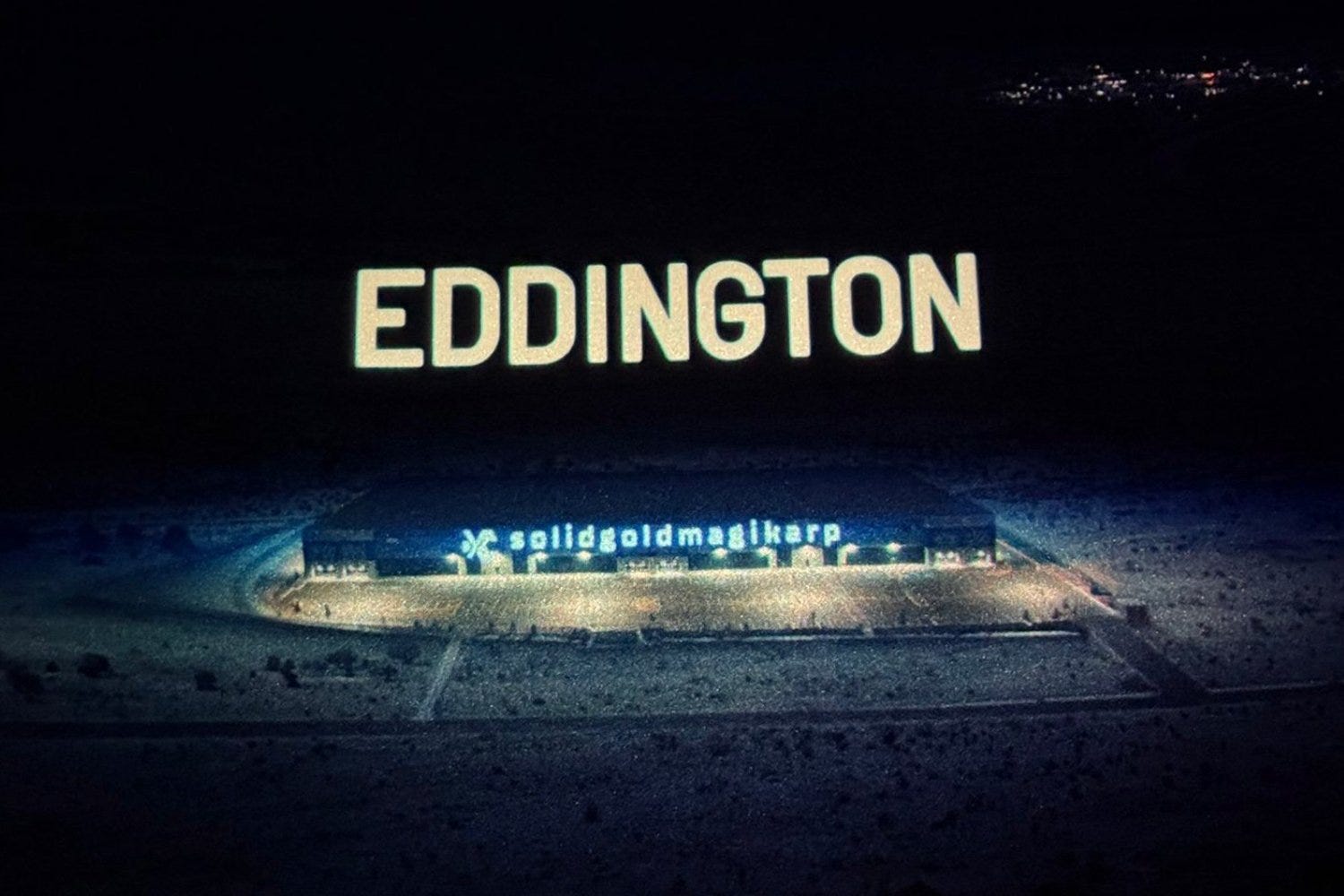
The final shot of Eddington
However, in its climax the film does pull something interesting out of its (ten-gallon) hat. The most successful element of Eddington is the subplot concerning a data centre that is to be built on the outskirts of the town, and which is the engine for much of the antipathy between Joe, who opposes it, and Ted, who welcomes it as a driver of economic growth. It’s here that Aster’s film most deftly combines the Western genre with the material prevalence of the online world, its true form revealed in the film’s final – and best – image, a night-time vista of the completed data centre glowing, spaceship-like, in the middle of the desert, some distance from Eddington, whose minor illumination renders it a pilot fish, swimming alongside its host as it sucks up the natural resources that sustain it. This is such a great, rich image: the data centre’s unearthliness, its domination of the frame, its transformation of the traditional Western landscape into something peripheral and uncanny. Yes, it’s a form of punchline – after all the killing, the town opts for its own obsolescence regardless – but what sets it apart from the film’s more facetious humour is that it’s a sincerely disturbing image, one that monumentally and materially reinscribes the threat on the landscape in a way that dwarfs the internecine conflicts of the town. I found myself wishing Eddington had leaned more in this direction. This is where the internet truly occurs: it’s material, and it’s terminal.
Fantastic piece here. Thank you for expanding my view on Eddington and Aster's oeuvre as well as shining a light on Haneke's work, which was unfamiliar to me before reading this. I found you on Twitter after I returned there just recently coming back for light-hearted Fantasy Football analysis and the occasional curation of good cinema/film, which explains finding your stuff.
I hadn't thought fully through the comedic element of Aster's horror, which I have felt but couldn't put my finger on. Again, thanks for all of this. I'm sure this will all come up in conversation with friends.