
Through a Camera Darkly: Blue Heron and the films of Sophy Romvari

In his book Camera Lucida, written after the death of his mother, Roland Barthes talks about what it means to look at a photograph of someone who has died:
[T]he person or thing photographed is the target, the referent, a kind of little simulacrum, any eidolon emitted by the object, which I should like to call the Spectrum of the Photograph, because this word retains […] the return of the dead.
Barthes suggests that in viewing a photograph of someone who is no longer here, we are also touched by the ‘rays’ that it emits. Barthes’ name for this emittance is ‘eidolon’, another word for a ghost or apparition. When we take a photograph or make a film, we seal off a moment that is instantly carried away from us into the past. The image remains the same, but we don’t. Time passes, and we grow and change while the person in the photograph lingers. But as Barthes says, and as Hungarian-Canadian filmmaker Sophy Romvari dramatises in her extraordinary debut feature Blue Heron, the image retains the ability to alter our relationship to time, to the world, and to the dead.
Blue Heron feels like the culmination of a series of short films Romvari has made over the last decade, most of which are concerned with viewing or searching images, both still and moving, as a way to address or circumvent the flaws of memory. Of course, a photograph or film can only tell what it shows, or what the cameraperson wants it to show. We look at old images in an attempt to understand someone who is no longer here – to look at their facial expressions and mannerisms, or the way they laugh or hold themselves – but the false objectivity of the image can fool us into imagining that we have somehow ‘captured’ them. Even the photograph, then, can conceal.
Romvari’s early work is preoccupied with the limits of seeing, both through memory and through captured images. In Blue Heron she goes further, creating a complex, multi-temporal structure that dramatises both a troubled childhood and a present-day narrative, where the daughter of that family attempts to connect with the image of the brother she has lost. In the first half of the film, we see the family of six in their home during the summer months. Eight year-old Sasha (Eylul Guven), the youngest child, plays with two of her brothers while her father photographs and films their everyday lives. But the oldest sibling, her half-brother Jeremy (Edik Beddoes), is isolated and inscrutable, given to performing dangerous or impulsive activities. As his parents struggle with their increasingly distant son, Sasha observes silently. The second half of the film jumps forward twenty years: Sasha is a filmmaker making a documentary investigating her family’s past, and attempting to understand the fateful decision that her parents made about Jeremy. As she returns to the site of her childhood home the film undergoes a dizzying narrative shift – one best experienced without foreknowledge – during which Sasha attempts to reconcile her childhood memories and the experience of her parents.
Romvari’s earlier films probe similar territory, notably the dramatic short It’s Him (2017) and the documentary Still Processing (2020). In It’s Him, a routine visit to the cinema is derailed when a young girl thinks she has seen her brother in the background of a shot: it’s not stated whether the brother is estranged or has died. The girl takes a photograph of the screen – a regular motif in Romvari’s films – to capture the blurry image and show it to her father. His ambivalent response, glimpsed only fleetingly, suggests concern over his daughter’s fixation. In Still Processing, which feels somewhat like a documentary precursor or counterpart to Blue Heron, Romvari herself looks through an archive of unseen photographs and films of her childhood, including images of two brothers who have since passed away. Romvari allows herself to be filmed in long shot opening the boxes of photographs and seeing them for the first time. It’s a remarkable and moving sequence, where the brutalist glass and metal surroundings of York University (from which Romvari graduated) contrast with the emotional intimacy of her expression. Watching it, you feel that you’re intruding on a private moment, complicated by a multiplanar framing device – us watching Romvari filming herself viewing images. It’s that balance of formalism and deep emotion that are at the heart of her project, and which find perhaps their fullest form in Blue Heron.
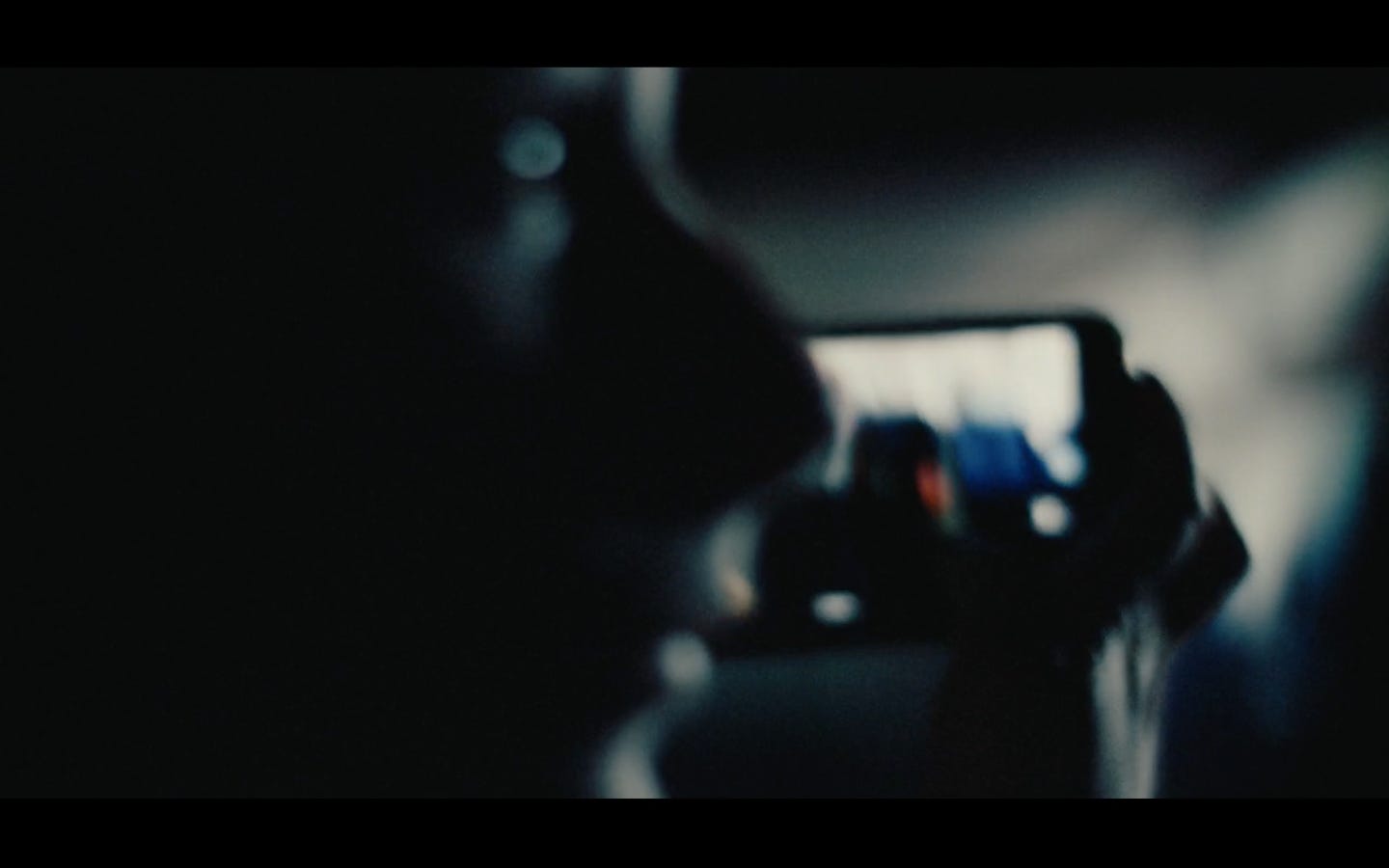
Filming the cinema screen: It’s Him (2017)
The formalism of Blue Heron, and its integration into the film’s mise-en-scene, is remarkable. Every frame has been composed to communicate the possibility of multiple ways of seeing, and as the film progresses, the arrangement of the frame transitions from a crowded, occluded image to a cleaner, more classically composed shot. Much of the opening half of the films is characterised by images of people partly hidden by an object in the foreground, or behind panes of glass. There’s an obvious analogy here to the distorting presence of the lens: when Sasha looks into Jeremy’s basement bedroom window to see her father trying to communicate with his son, the image is bisected by both the window frame and the vertical edge of a pane of glass. The full image is obscured, remediated, the family viewed through a rectangular aperture that recalls a compromised version of both the cinema screen and the projection booth’s window.
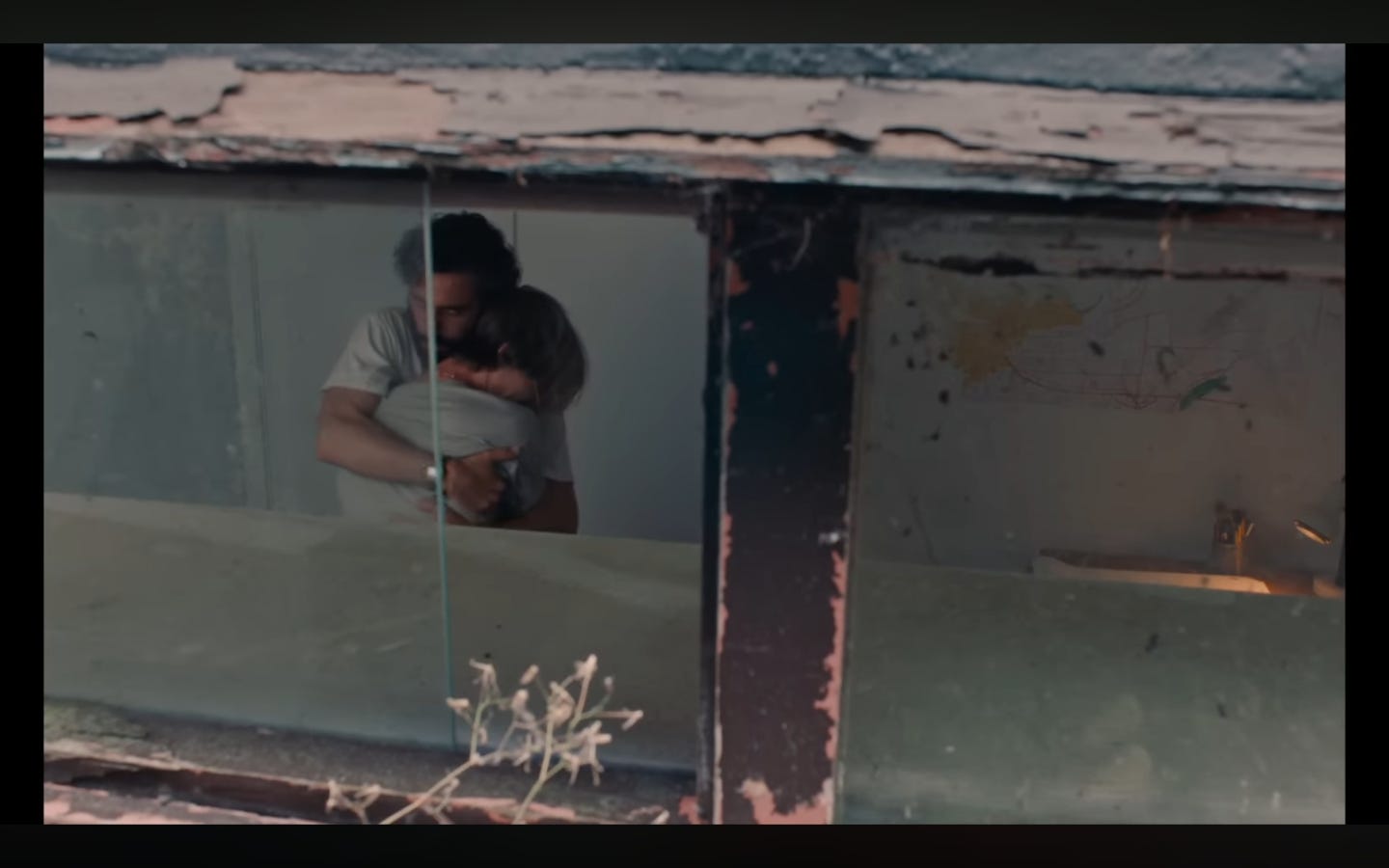
The multiplanar aperture: Blue Heron (2026)
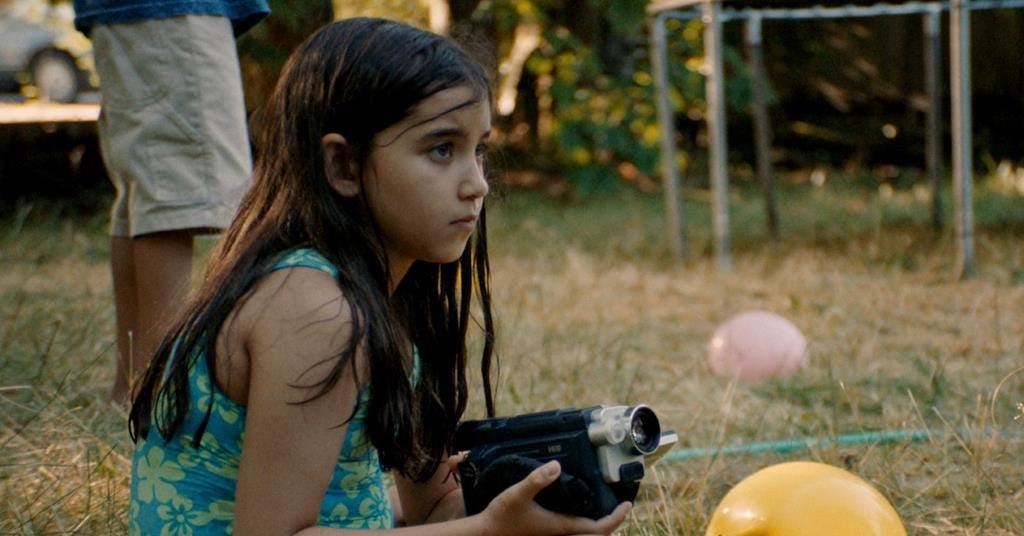
Romvari goes further: in a scene where Jeremy is brought home by the police for shoplifting, Sasha’s father asks her to hold the camera in order to speak to Jeremy. After a long-held shot of Jeremy and his parents at the front door, there is a cut to Sasha sitting alone on the grass, the camera cradled in her lap. When I saw this shot, it made me gasp: as a shorthand for the child’s responsibility for a family’s legacy, and the limitations of the camera to capture the emotion of a particular moment, it has an extraordinary, visceral power. It also hints at something else, that there might be a way to capture that moment, but it requires distance from both childhood and the camera to enact this, and so what we see is a third image of the child and the apparatus, held within an emotional dramatization of the original event.
It’s a testament to Romvari’s surety as a director that these moments do not simply come across as elaborate meta-constructions but as fully-fledged, gut-punch emotional moments. A number of critics have made reference to Charlotte Wells’ Aftersun (2022) in relation to Blue Heron, and there’s no doubt that the films come from a similar place: Wells also has an excellent sense of frame arrangement, and the plot – filmmaker daughter revisits and remediates the loss of a family member – is similar. But Romvari’s film is more explicit about the process of mediation itself, making the apparatus of filmmaking and photography more central to the mise-en-scene. The title Still Processing, with its implied synthesis of emotion and technology, could also be applied to Blue Heron. In Romvari’s film I also saw the traces of a longer tradition of independent and autofictional film, from Chantal Akerman, whose Jeanne Dielman is surely referenced here during a scene of potato-peeling, to the complex compositions of Jon Jost’s overlooked The Bed You Sleep In (1993), where deception of memory is often represented in the occluded image, to Céline Sciamma’s Petite Maman (2021) in which childhood becomes a concrete place you can physically revisit.
In one of the earliest scenes of Blue Heron, Jeremy lies motionless on the family porch. A neighbour has called the house in concern. His father relates to his wife that the neighbour has said “our son is dead on the front step. I told him not to worry; he will come back to life soon”. This exchange is portentous, foregrounding the tragedy to come but also prefiguring the formal and cinematic process of resurrecting the dead. Even more so than with Barthes’ photograph, to make a film about someone who has died is to artificially bring them back. Romvari’s film sits with the ambiguity of that process – to resurrect someone in an image is not the same as turning back time. Instead, it’s the manufacturing of an image of the past informed by fallible memory. It won’t ‘fix’ anything, but it might be able to clarify something about those of us who are left. From this process comes an art which can console but never allows that consolation to settle into sentimentality or resolution. It is just that, a process. But from it can come something quite remarkable.
Blue Heron is in cinemas now. My book The End of the Reel, on cinema, technology and memory, is forthcoming from Ortac Press in late 2027/early 2028.